04 / From Question to Pilot
A disciplined pathway to a credible first project
Space is not the starting point. The starting point is a high-value problem with a defensible reason to investigate a non-terrestrial environment.
- 01
Frame the challenge
Define the unmet need, business relevance, target outcome and why conventional approaches may be insufficient.
- 02
Test the hypothesis
Assess scientific rationale, technical feasibility, platform constraints, intellectual property, regulation and preliminary economics.
- 03
Build the consortium
Select the relevant scientific, engineering, platform, manufacturing, data and commercial contributors.
- 04
Design the pilot
Translate the concept into requirements, work packages, governance, schedule, funding logic and decision gates.
- 05
Validate and scale
Use evidence from the pilot to decide whether to stop, iterate, expand or build a repeatable commercial pathway.
Space relevance gate
Only when space changes the experiment
Space is not the starting point. Before an orbital pilot is considered, the project must demonstrate a credible reason why altered gravity conditions could produce meaningful scientific or industrial value.
- 01What is the terrestrial limitation?
- 02Which gravity-dependent mechanism matters?
- 03What measurable outcome could change?
- 04Can the hypothesis be de-risked on Earth first?
- 05Would a positive orbital result create meaningful scientific or commercial value?
This is a decision framework used in discussion with the project team, not an automated scientific scoring tool.
The commercial test
Does microgravity improve the evidence?
Does it improve product or process performance?
Does it enable or accelerate development?
Can the expected value justify the additional mission complexity and cost?
Microgravity should be considered only when the expected scientific or industrial value can justify the additional complexity of a space-based experiment.
Earth to orbit to return
The mission lifecycle behind a pilot
Select a stage to see the critical question, the evidence required and the relevant capability.
Critical question
What decision depends on the answer?
Evidence required
A defined unmet need with business or scientific relevance.
Relevant capability
Challenge qualification
Critical question
How far can the hypothesis be taken on Earth?
Evidence required
Analogue, clinostat and simulated-microgravity results.
Relevant capability
Connected scientific capability
Critical question
Which variable is actually being tested?
Evidence required
Controls, sample numbers and measurable endpoints.
Relevant capability
Experiment systems and payload engineering
Critical question
Can the experiment survive the mission envelope?
Evidence required
Requirements, containment, fluidics, thermal, power and data budgets.
Relevant capability
Experiment systems and payload engineering
Critical question
Does the hardware meet the platform's verification levels?
Evidence required
Environmental test results and a traceable verification matrix.
Relevant capability
Environmental qualification (in development)
Critical question
Which mission architecture fits the use case?
Evidence required
Interface control documents and provider acceptance.
Relevant capability
Platform and flight pathways
Critical question
How is the experiment operated and monitored?
Evidence required
Operations plan, telemetry, crew or autonomous procedures.
Relevant capability
Experiment operations
Critical question
How is sample integrity preserved on the way back?
Evidence required
Cold chain, timelines and recovery logistics agreed in advance.
Relevant capability
Return, recovery and post-flight translation
Critical question
What did altered gravity change, and by how much?
Evidence required
Comparative analysis against matched ground controls.
Relevant capability
Data, AI and autonomous research
Critical question
Stop, iterate, expand or commercialise?
Evidence required
Evidence sufficient for an investment or development decision.
Relevant capability
Pilot pathway governance
Platform and flight pathways
Platform-agnostic by design
Where a project reaches sufficient scientific and technical maturity, Space BioDistrict helps connect the consortium with relevant international platform and flight providers. Any access remains subject to the provider's qualification, commercial, regulatory and scheduling requirements.
Mission architecture follows the use case. Depending on scientific, engineering and return requirements, a project may be better suited to terrestrial analogue testing, reduced-gravity environments, automated orbital platforms, commercial stations or return-capable free flyers.
07 / Who we work with
For organisations ready to move from curiosity to a decision
Pharma and biotech
Explore whether microgravity can create meaningful scientific or product-development advantage.
Space infrastructure providers
Connect platform capabilities with qualified industrial demand and credible end-user pathways.
Research organisations
Build translational consortia combining scientific excellence with implementation and market relevance.
Deep-tech companies
Enter Swiss and European collaborations through manufacturing, automation, sensing, robotics, AI or data.
Investors and strategic partners
Access curated projects and teams at the intersection of space infrastructure and life-science value creation.
Companies entering Lucerne
Connect with relevant ecosystem organisations, technical capabilities and potential pilot pathways in Lucerne, with official investment and location-support functions remaining with the competent economic-development organisations.
05 / Consortium
The right organisations,around one objective
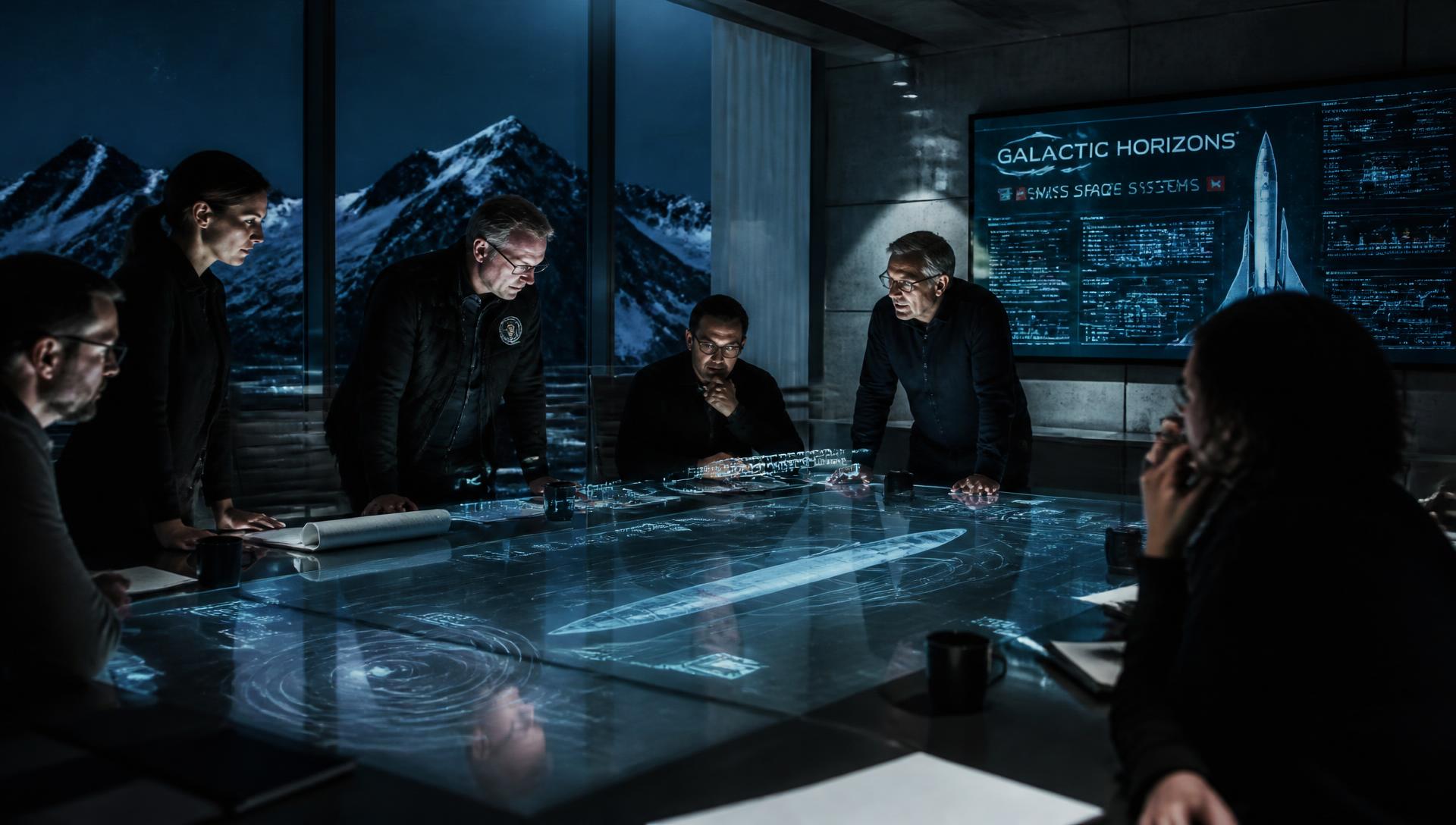
Structure before ambition: work packages, governance, funding logic and decision gates agreed by every contributor before a pilot is committed.